

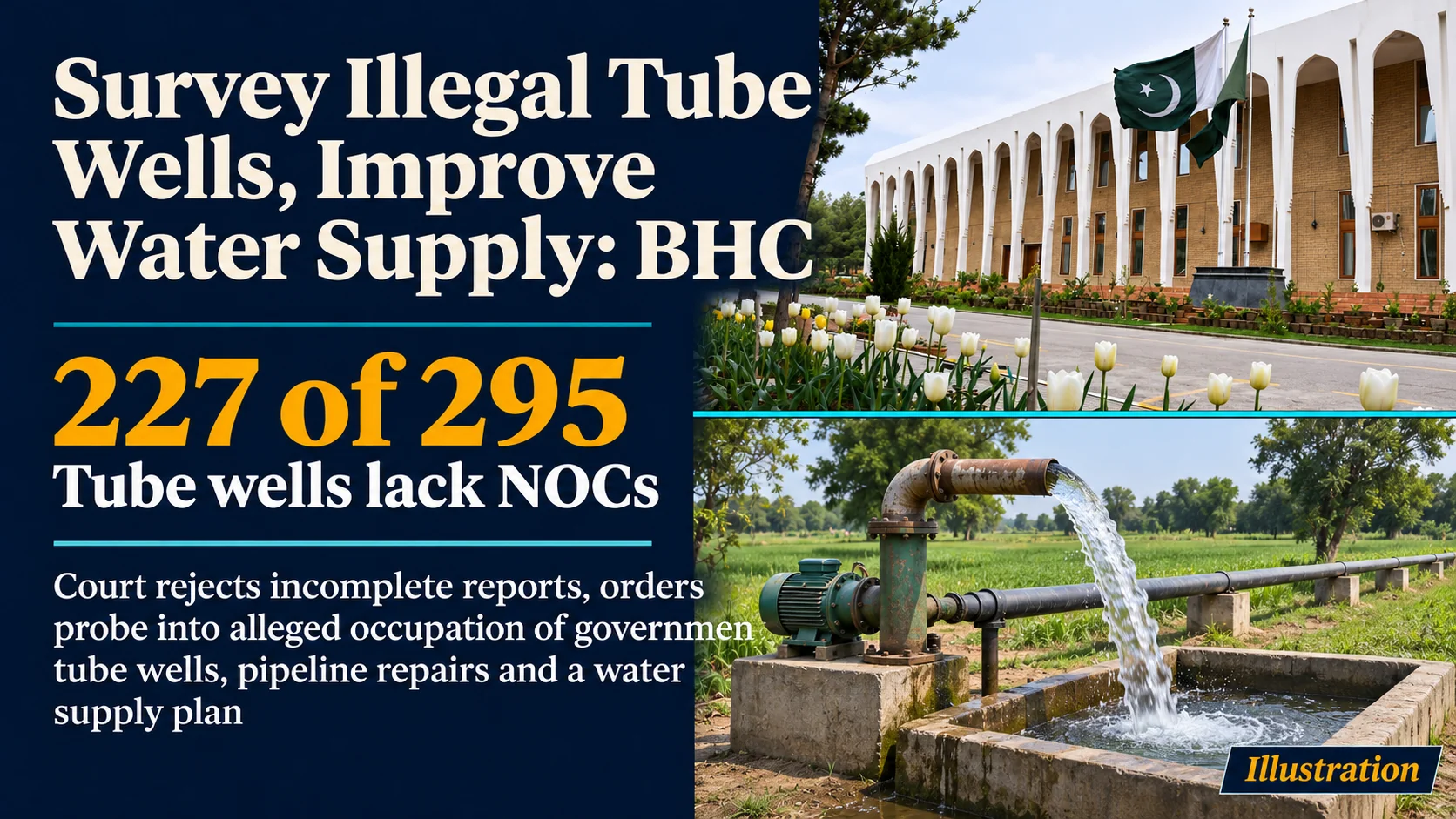
QUETTA | The Balochistan High Court (BHC) has ordered a comprehensive survey of illegal tube wells in Quetta and surrounding areas, an investigation into alleged illegal occupation of government tube wells, and effective measures to improve water supply across the city.
Court rejects incomplete reports after finding 227 of 295 tube wells lack NOCs; orders investigation into alleged illegal occupation of government tube wells, pipeline repairs and comprehensive water supply planning
A division bench comprising Chief Justice Muhammad Kamran Khan Mulakhail and Justice Muhammad Najmuddin Mengal issued the directives while hearing a constitutional petition concerning water supply problems in Quetta.
Survey Illegal Tube Wells, Improve Water Supply: BHC
During the hearing, a report submitted by the Deputy Commissioner Quetta East revealed that 227 of 295 tube wells were operating without No Objection Certificates (NOCs), while only 68 possessed valid NOCs.
The court rejected the report as incomplete, observing that it failed to provide comprehensive information about the total number and legal status of tube wells operating in Quetta and its surrounding areas.
The bench also expressed dissatisfaction with the report submitted by a committee headed by the Public Health Engineering (PHE) Secretary and the minutes of its November 5, 2026, meeting.
The court directed the PHE Secretary to constitute an effective team to conduct a fresh, comprehensive survey of all tube wells and submit detailed findings identifying illegal installations.
Regarding allegations of unauthorized occupation of government tube wells, the bench directed the Deputy Commissioners of Quetta East and West to investigate the matter and submit reports at the next hearing.
Meanwhile, officials of the Balochistan Water and Sanitation Authority (B-WASA) informed the court that approximately 80 percent of its pipelines used to supply water from private tube wells in certain areas of Hazara Town had been disconnected. Further surveys were required to assess the situation in other localities.
Officials reported that nine tube wells near Karkhasa Dam were operational, supplying water to eastern and western parts of Hazara Town on alternate days.
Arrangements were also underway to transfer water from four tube wells in Sajawalabad to storage facilities, including a 300,000-gallon reservoir at Hazara Town Cemetery.
However, five tube wells near Akhtarabad Dam remained nonoperational because electricity connections, pipeline installations and other essential construction work had not been completed.
The petitioner’s counsel informed the court that water was being supplied to seven blocks of Hazara Town, but distribution remained irregular and severely limited, causing difficulties for residents.
The bench directed the concerned B-WASA engineer to immediately repair or replace deteriorated pipelines, complete necessary infrastructure work and submit a progress report at the next hearing.
The PHE Secretary was also instructed to submit a comprehensive long-term plan addressing Quetta’s future water requirements and sustainable supply arrangements.
The court ordered that a copy of its directives be forwarded to the Office of the Additional Advocate General and adjourned further proceedings until December 23, 2026.

