

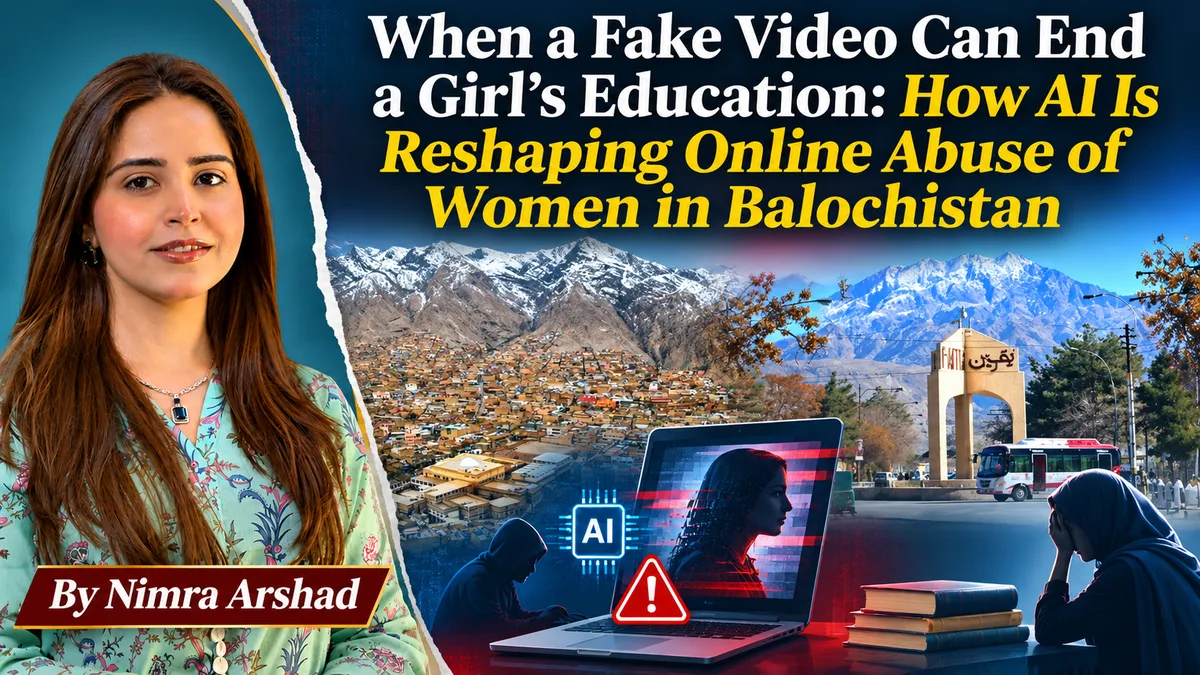
By Nimra Arshad
For a woman in Quetta, or anywhere in Balochistan, a fake video of herself is not a technical question. It can decide whether she goes back to university, whether her brother takes her phone and whether her family believes her. As artificial intelligence makes such fakes easy to produce, the meeting point of AI and gender-based violence in the province is a story that deserves far more attention than it gets.
Artificial intelligence now let’s abusers fabricate evidence with a single photograph. In Balochistan, where family reputation can outweigh facts, internet shutdowns, distant cybercrime offices and fear of stigma leave many women without help.
Imagine opening your phone and finding a video of yourself. Your face, your voice, your dupatta. You are doing something you have never done, in a place you have never been, with a person you barely know. The caption says you have brought shame on your family.
Technology-facilitated gender-based violence, or TFGBV, is violence carried out through phones, social media, messaging apps and other digital tools. It includes blackmail, stalking, hacking, sharing private images without consent, sextortion and coordinated smear campaigns.
It is not a separate world from “real” violence. As one Pakistani commentator put it, it sits on the same continuum as every other form of gender-based violence, a reflection of the same inequalities.
AI has added a new and frightening tool to that list: the ability to fabricate. With a free app and a single photograph, someone can now produce a convincing fake image, video or voice clip. No hidden camera is needed. No private moment is needed. Just a face.
The best data available in Pakistan comes from the Digital Rights Foundation (DRF), whose helpline logged 3,171 complaints of tech-facilitated gender-based violence in 2024. In cases involving non-consensual intimate images, 85 percent targeted women. In 2025, women reported 1,709 cases to the helpline, compared with 1,279 reported by men.
Deepfakes are already part of that picture. DRF recorded 155 deepfake cases among the 1,371 complaints it received in 2023. DRF’s founder, Nighat Dad, has described the trend as a disturbing new frontier of gender-based violence, with cases rising steadily.
For Balochistan, the more important finding concerns who is reporting. Of the cases DRF handled in 2025, Punjab accounted for 69.5 percent. DRF itself links that to population size and to better access to reporting mechanisms. In other words, a province that appears to have fewer cases may simply have fewer women able to report them.
DRF also noted that 892 complaints came from cities with no office of the National Cyber Crime Investigation Agency (NCCIA), and that 79 percent of cyber harassment cases were referred to that agency, yet access to justice remains uneven.
When the numbers from a place are small, it is worth asking who is missing from them.
Experts who study the issue say AI does not create misogyny. It magnifies it. It takes old beliefs, that a woman’s reputation is her family’s property and that a photograph is proof of guilt, and gives them faster, cheaper and more convincing tools. Three problems stand out.
The proof problem. Before, an abuser needed a real photo or video. Now none is needed. A woman who has done nothing can still be targeted.
The speed problem. A fake can reach hundreds of WhatsApp groups before a woman even learns it exists. Fact-checkers can later prove it is false, but the correction rarely travels as far as the lie.
The silence problem. Because “the video exists” is often treated as enough, many women choose not to fight at all. They delete accounts, stop posting, leave their studies or stay quiet. That silence is exactly what the abuser is after.
Every province has its own version of this problem. Balochistan’s has particular layers.
Honour, reputation and family. In a tribal and conservative setting, an accusation can matter more than the evidence. That is exactly the power a fake exploits.
Low access to education to begin with. Al Jazeera reported in 2020 that female literacy in Balochistan stood at 33.5 percent, and that fewer than 12 percent of women in the province went past primary school. Every girl who reaches university has already beaten difficult odds. Anything that gives a family a reason to pull her out is a serious loss.
Connectivity that comes and goes. In August 2025, mobile internet was suspended across all 36 districts of Balochistan for what authorities called security reasons. For most of the province’s roughly 15 million people, mobile data is the only way to get online. The Balochistan High Court ordered it restored after about two weeks. Whatever the security reasoning, the effect on women is easy to see: less reliable access to online classes, helplines, reporting tools and trusted contacts, and less chance to learn digital safety skills.
Distance from justice. DRF’s own data shows how far services can be from the people who need them. A complaint process that is difficult, far away or requires travel is, for many women in rural Balochistan, no process at all.
To understand what is at stake, there is no need to look abroad. Quetta only has to remember what happened at the University of Balochistan in 2019.
That autumn, a scandal broke on the campus. Hidden cameras had been found in places such as washrooms and smoking areas, and footage from them was allegedly used to blackmail and harass students, many of them women. The FIA traced a number of videos, the Balochistan High Court took notice, and the vice chancellor eventually stepped down. Students, led by young women, marched on the campus demanding justice.
This was not an AI case. It was an older form of technology-facilitated violence. But the way it unfolded is the reason it matters today.
One of the people Al Jazeera spoke with, a student whose identity the outlet protected, had missed the deadline for her admission forms. A teacher offered to help. After he did, she says, he began sending her messages late at night and threatened to cancel her admission if she did not respond. She described how she had always addressed him with respect and how, after that, she felt her confidence drain away.
Other students told the reporter why women stayed silent. A 19-year-old law student said, “On account of our families, we can’t even talk about it.” Many parents, the report found, pulled their daughters out of the university altogether.
The lesson is uncomfortable but clear. In Balochistan, the harm of digital abuse rarely stops at the screen. It travels into the family, into the classroom, into the decision about whether a girl may keep studying. Now imagine that same dynamic, with technology that can invent evidence instead of just stealing it.
Several things keep women in Balochistan from getting help. The first is fear and stigma. Surveys cited in the Pakistani press found that many women feel embarrassed to report harassment and doubt that the state can protect them.
The law also lags behind the technology. As of early 2025 reporting, Pakistan still had no legislation specifically addressing sexualized deepfakes, so survivors had to rely on broader cybercrime provisions.
Procedures add another barrier, because they often assume a city address. Commentators have pointed out that having to file a complaint in person discourages women in rural areas. Finally, there is little local data. Without reliable figures from Balochistan, programmes and policies are planned in the dark.
The suggestions below are practical, and most are already within reach of communities, partners and local government.
The first step is to bring digital safety into spaces women already trust. Women and girls friendly spaces, community centres, schools and colleges can host short, practical sessions on locking down accounts, spotting a fake and what to do if a private image is threatened. The message should be simple: don’t panic, don’t pay, save the evidence, and tell someone you trust. This material should also be taught in the languages people actually speak. Awareness material in Urdu, Balochi, Pashto and Brahui, with visuals for women with limited literacy, will reach far more people than English posters.
Reporting also has to be reachable. That means pushing for remote complaint options, outreach by the NCCIA and women officers who can receive complaints, and clear referral routes to helplines such as DRF’s. A woman should not have to travel far or explain herself to a room of strangers. The legal gap needs closing too. Advocates should push for explicit recognition of synthetic sexual imagery, faster takedown procedures and survivor-centred investigation timelines.
Institutions must be held to account as well. Universities need working anti-harassment committees, clear complaint notices and strict rules on who controls campus cameras and data. The 2019 investigation noted that no standard procedure governed how camera footage could be used.
Families, elders and men also have to be part of the conversation. If a fake video can end a girl’s education because her family assumes the worst, then fathers, brothers, imams and tribal elders are part of the solution. The first question should be “Is this real?” and the second should be “How do we protect her?”
Two further steps matter. Authorities should use targeted measures instead of province-wide internet shutdowns, so that women’s access to education, support and information is not collateral damage. And helplines, NGOs and government departments should record cases by district and gender, with consent and privacy protections, so the true scale becomes visible.
Go back to that video of yourself, the one you never made. In Balochistan, whether it destroys you depends less on the software than on what happens around you: whether your family believes you, whether your university protects you, and whether there is a person to call and an officer who will answer. Technology is only the delivery mechanism. The real work, as ever, is changing what happens when the message arrives.
There are signs that this conversation is moving. In December 2025, more than 85 women lawyers gathered in Quetta, supported by the Balochistan Bar Council and UNDP, to discuss the challenges of practicing law in the age of AI, with a focus on tech-facilitated gender-based violence. That matters, because women who understand both the law and the technology are exactly who survivors need beside them.
The 16 Days of Activism are a good moment to ask a simple question. When the next fake arrives, will the girl at the centre of it be alone, or will she have people ready to say, “We know it’s fake, and we are with you”? The answer is something all of us can shape.

