

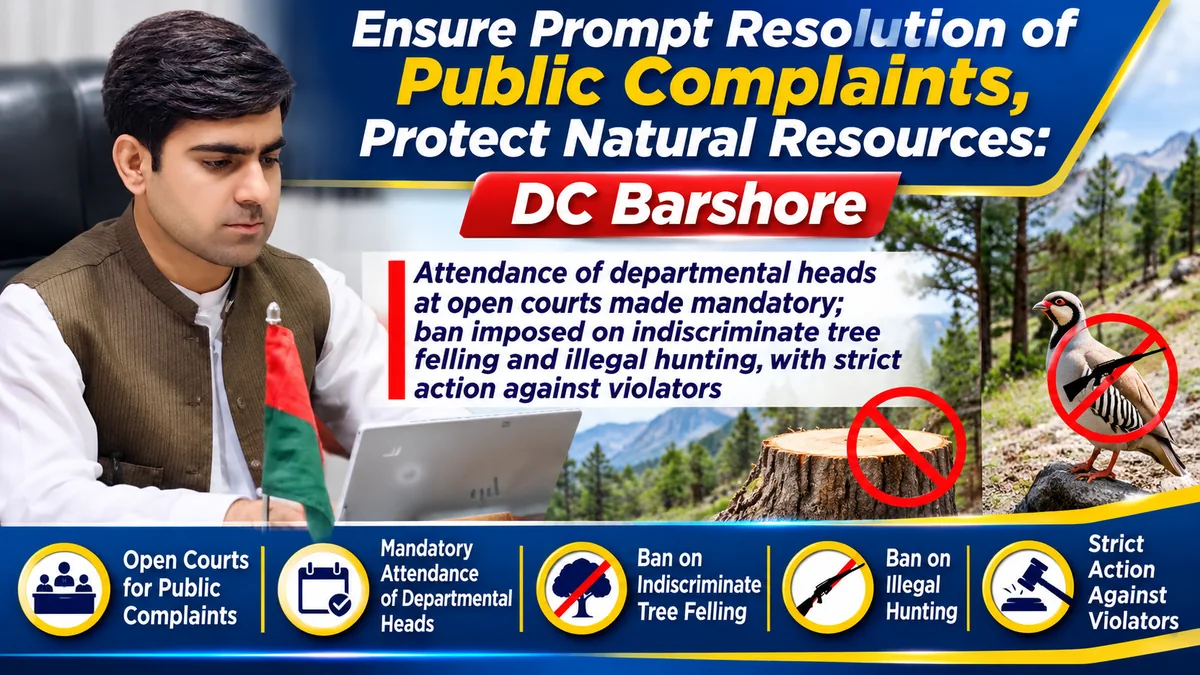
BARSHORE | Deputy Commissioner Barshore Flight Lieutenant (Retd.) Khalid Shams has directed officials to ensure the prompt resolution of public complaints, warning that negligence in public service delivery will not be tolerated. He has also imposed a complete ban on indiscriminate tree felling and illegal wildlife hunting across the district to protect the environment and conserve natural resources.
Attendance of departmental heads at open courts made mandatory; ban imposed on indiscriminate tree felling and illegal hunting, with strict action against violators
Speaking during an open court, the deputy commissioner said such sessions would be held regularly under the Balochistan government’s good governance policy to address citizens’ grievances, improve public services and strengthen institutional accountability.
He made the attendance of district heads of education, health, public health engineering, irrigation, agriculture, forests, local government and law enforcement agencies at open courts mandatory, directing officials to submit implementation reports within stipulated deadlines.
Khalid Shams emphasized that cooperation among the district administration, local communities, civil society and tribal representatives was essential to promoting sustainable development, peace and prosperity.
Meanwhile, the deputy commissioner imposed an immediate ban on indiscriminate tree felling and illegal wildlife hunting, warning that violators would face strict legal action under the Balochistan Forest Act 2022 and other relevant laws.
He described forests and rare wildlife as valuable national assets, stressing that their conservation was a collective responsibility essential to maintaining ecological balance and protecting future generations.
He directed the Forest Department, police and other relevant agencies to ensure strict enforcement of the ban and urged citizens to report violations to the relevant Divisional Forest Officer or the Assistant Commissioner Barshore’s office.
The deputy commissioner reaffirmed the administration’s commitment to public welfare, environmental conservation, institutional accountability and improved public service delivery.

